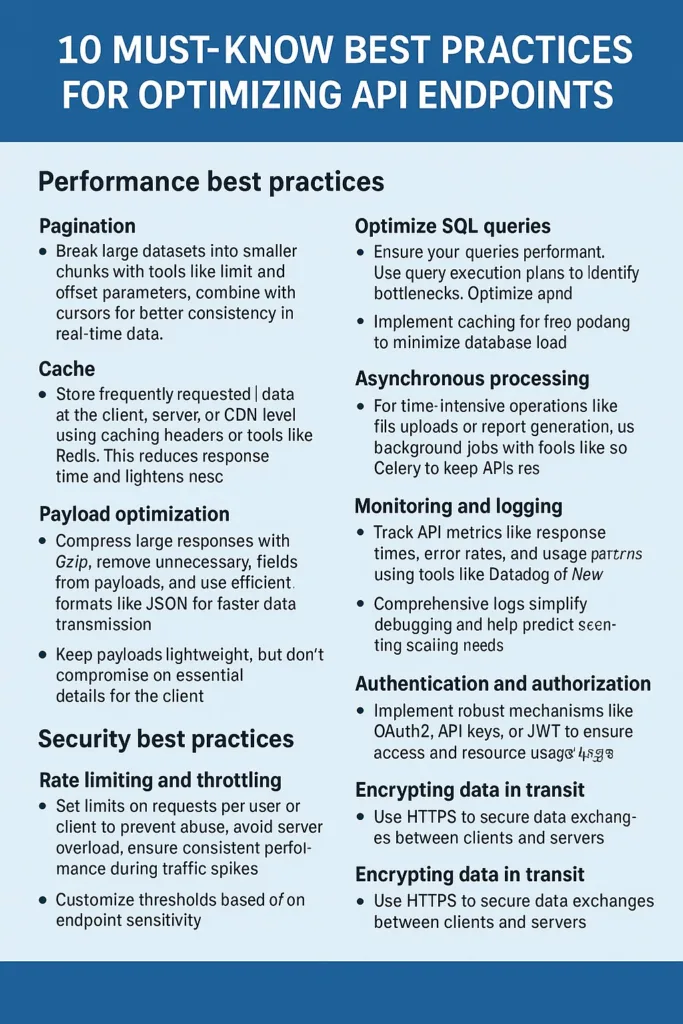
10 Essential Best Practices for Building High-Performance and Secure API Endpoints
APIs are the backbone of modern applications, that enables seamless communication among systems, services, and users. However, poorly designed endpoints can lead to slow responses, server overload, and even could expose to security risks.
To help you get the most out of your APIs, here are 10 must-know practices to ensure they’re optimized for both performance and security.
Performance Best Practices
1. Use Pagination for Large Data Sets
Instead of sending massive amounts of data in one response, break it down into smaller pieces. Implement pagination using tools like limit and offset or cursor-based methods. This not only improves speed but also prevents clients from crashing when handling bulky responses.
2. Implement Smart Caching
Reduce unnecessary requests to the backend by caching frequently requested data. Whether at the client, server, or CDN level, caching drastically improves response times. Tools like Redis or proper HTTP caching headers can help.
Must to remember to handle cache expiration properly to avoid serving outdated information.
3. Fine Tune SQL Queries
Inefficient queries can be a silent killer of performance. Use query execution plans to analyze bottlenecks, add indexes where needed, and cache results of repetitive queries.
4. Keep Payloads Lightweight
Don’t send more data than necessary. Compress responses with Gzip, strip out redundant fields, and prefer efficient formats like JSON. The goal is to minimize bandwidth usage without cutting essential details that clients depend on.
5. Asynchronous for Heavy Tasks
Operations like file uploads, report generation, or bulk processing shouldn’t block your API responses. Offload them to background jobs using tools such as RabbitMQ or Celery. Return a task ID so clients can check progress without waiting for the entire process to finish.
Security Best Practices
6. Apply Rate Limiting and Throttling
Protect your APIs from abuse and traffic surges by limiting the number of requests a client can make in a set timeframe. Define different thresholds depending on the sensitivity of the endpoint to keep your servers safe and fair for all users.
7. Validate and Sanitize User Input
Never trust raw input. All incoming data should be validated and sanitized to guard against SQL injection, cross-site scripting (XSS), and other malicious attacks. Apply proper validation ensures your API stays reliable and secure.
8. Monitor and Log Everything
Visibility is key to maintaining healthy APIs. Track response times, error rates, and traffic spikes with monitoring tools like Datadog or New Relic. Detailed logs make it easier to debug issues, identify performance bottlenecks, and even predict scaling requirements before they become urgent.
9. Strengthen Authentication and Authorization
Make sure only the right users have access. Secure your endpoints using methods like OAuth2, API keys, or JWT (JSON Web Tokens). Enforce strict authorization rules so resources are never exposed to unauthorized clients.
10. Encrypt Data in Transit
Always protect sensitive information while it travels between client and server. Use HTTPS (TLS) to prevent attackers from intercepting or tampering with data. Encryption isn’t optional—it’s a must-have for any serious API.